
2026 Third Quarter CIO Letter: The Bond Market Is Calling
Kasey Wopperer, Co-Founder & Chief Investment Officer
Written October 13th, 2026

At a Glance
Consumer spending and AI investment remain important supports for growth, but both could amplify a downturn if financial markets weaken.
Long-term, fixed-rate debt has delayed the effect of higher interest rates; refinancing gradually removes that protection.
The federal government and corporations are competing for capital, increasing the importance of Treasury supply and long-term yields.
We are selectively adding high-quality municipal bonds where after-tax compensation has improved, while remaining disciplined about duration.
During the 2013 Berkshire Hathaway Annual Meeting, Warren Buffett compared interest rates to gravity, explaining that just as gravity influences the movement of physical objects, interest rates exert a powerful force on asset prices.
For much of the past fifteen years, the gravitational pull has been unusually weak. Low interest rates, extraordinary monetary stimulus, and abundant and inexpensive capital helped propel asset prices higher as investors became accustomed to this environment.
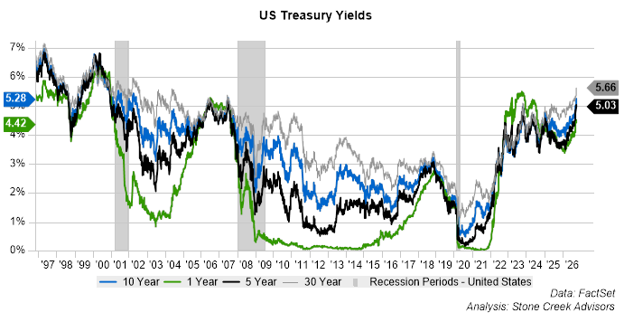
The forces influencing interest rates are changing. Government borrowing requirements are enormous, inflation remains above the Federal Reserve's target, geopolitical tensions continue to threaten energy prices, companies are competing for capital to finance the Artificial Intelligence (AI) investment cycle, and some of the largest historical buyers of U.S. Treasuries are buying less or even selling. The implications extend beyond the bond market, affecting corporate profitability, equity valuations, consumer spending, and economic growth.
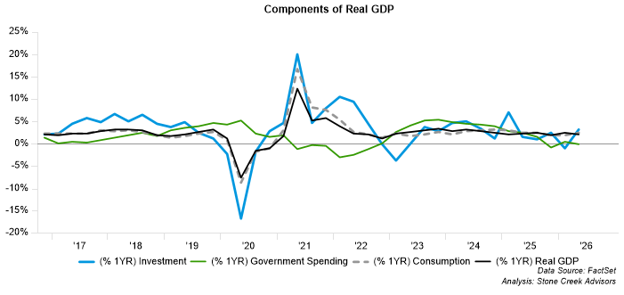
Economic growth remains resilient, corporate profitability is strong, and equity markets reflect considerable optimism, but some of the foundational supports are weakening. While consumption remains healthy, consumers are increasingly stretched and labor force growth has slowed. Capital investment is becoming concentrated in a narrow group of companies and government deficits are massive despite economic expansion.
The economy is becoming increasingly dependent on fewer sources of growth at a time when the demand and cost for capital is accelerating and inflation risks have increased. These changes have been mostly viewed through the equity market lens, but those forces created considerable volatility in the bond market during the quarter.
Growth Is Holding Up, but What's Supporting It?
Households have navigated the highest inflation in decades, rapidly rising interest rates, deteriorating housing affordability, and historically weak consumer confidence, yet consumption continues to expand.
For more than two years, consumer spending has grown faster than personal income. Historically, personal consumption and income have moved closely together, with a correlation of approximately 0.72 since 1960. Over the past four years, that correlation has fallen to approximately 0.25.
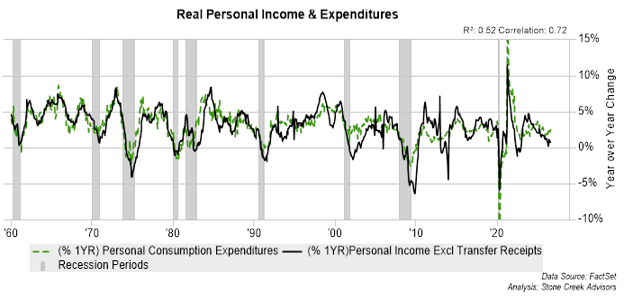
Households have increasingly relied on accumulated savings, borrowing, and rising asset values to sustain spending rather than income growth. Maintaining this deficit indefinitely will become harder as personal savings rates are low and consumer debt is building.
We do not expect consumers to stop spending simply because financial pressures are building. As long as employment holds up and rising asset prices make people feel wealthier, spending may remain resilient. But if markets roll over, falling portfolio values can weaken the wealth effect and spending, which may hurt corporate revenues, earnings, and employment creating the potential for a self-reinforcing downward spiral.
There is also a temporary source of support that could mask some of these underlying pressures. The 2025 reconciliation act provided a boost to disposable income and consumption through lower individual taxes and larger-than-usual refunds. The Congressional Budget Office estimates that the legislation's positive effect on economic growth peaks in 2026 before beginning to diminish in 2027.[1] While this tax-related increase in disposable income can support spending in the near term, the initial boost to its growth rate is not expected to repeat annually without the implementation of further measures.
As that support fades, spending will become more dependent on employment, wage growth, and household balance sheets where we are beginning to see strain. Delinquencies on auto loans and other consumer credit have increased, student loan payments have resumed, and the cumulative effects of inflation continue to pressure household budgets.
Renewed increases in energy prices add another burden. Oil acts as a tax on consumers. Money spent filling a gas tank cannot be spent elsewhere. Historically, higher oil prices have affected consumption with a lag, suggesting the full effects of this year's energy disruptions may lie ahead. Diesel prices are also important because they are embedded in the cost of moving almost everything around the economy.
For decades, the U.S. benefited from an expanding labor force. When labor force growth slowed from demographics, immigration filled the gap and people worked later into their life, allowing labor force expansion to continue.
Today, the unemployment rate remains relatively low, traditionally a signal of economic strength. But a tight labor market does not necessarily equate to a strong one. Over the most recent twelve months, labor-force growth has turned negative, averaging a decline of approximately 81,000 workers per month.
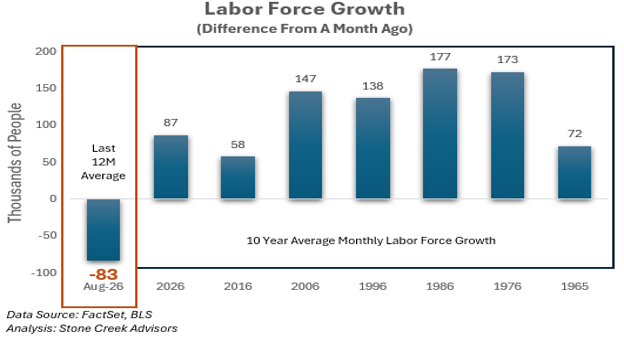
Economic growth ultimately comes from two sources: more people working or more output from each worker. If we can no longer rely on the first, we become increasingly dependent on the second.
The Productivity Boom Has a Price
Rising labor costs, demographic constraints, and the need for efficiency were already creating incentives for companies to invest in productivity-enhancing technologies. AI accelerated that trend. Companies capable of producing more with fewer resources can improve profitability and competitiveness by generating stronger growth without requiring equivalent labor force expansion.
But the scale of necessary investment is extraordinary. Hyperscalers are spending hundreds of billions of dollars building data centers, purchasing chips, developing AI models, and securing electricity necessary to power them. There is a difference between the potential economic benefits of AI and the returns investors will ultimately earn financing its development.
This spending has supported economic growth and generated exceptional earnings thus far, especially in the first half of 2026. Technology companies account for a disproportionate share of that growth. But outside of AI-related investment, private capital expenditures have been contracting. An increasing share of investment growth is being generated by a relatively small group of companies participating in the AI buildout.
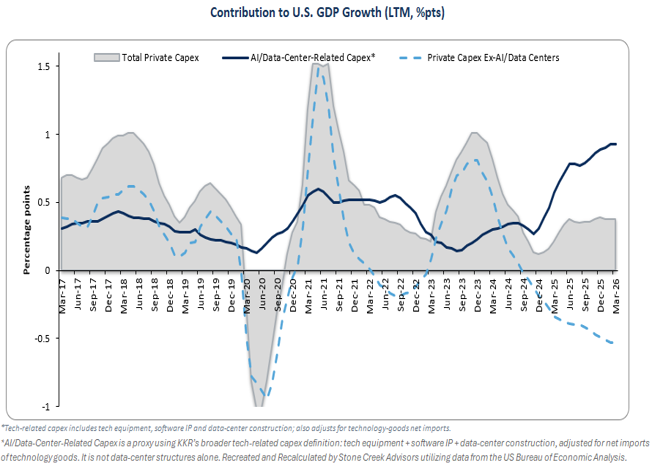
Initially, these companies were able to finance much of their spending internally through enormous free cash flow, but as capital expenditures consume a larger share of cash generation, companies are turning to external financing. Corporate gross debt issuance reached approximately $2.2 trillion through September[2], roughly matching the amount issued during all of 2025.[3] We believe the market is underappreciating this change.
We do not expect hyperscalers to voluntarily abandon their investment plans while financing remains available and investors reward expansion. Competition for AI capacity creates a powerful incentive to keep building. But tighter credit conditions, higher yields, weaker equity valuations, or disappointing returns could eventually force a pullback. While more disciplined spending could help hyperscalers, the chipmakers, data-center equipment suppliers, electrical infrastructure companies, and other “picks and shovels” beneficiaries could experience an abrupt decline in orders, expectations, and valuations.
Historically, technology companies were among the economy’s largest generators of excess cash. Increasingly, some of those same companies are becoming significant consumers of capital. Historically transformative technologies, including railroads, telecommunications, and the internet, have attracted more capital than could initially earn an adequate return. Investors repeatedly overpaid to finance their development.
The questions are: how much capital will be required for AI to succeed, where will that capital come from, what returns will that capital generate, and who will ultimately capture those returns?
The Government Is Competing for the Same Capital
The federal government faces a financing challenge of its own. In 2025, the U.S. collected approximately $5.2 trillion in revenue and spent roughly $7 trillion, producing a deficit of approximately $1.8 trillion. Historically, deficits of this magnitude occur with recessions, major wars, or other disruptions, not a growing economy.
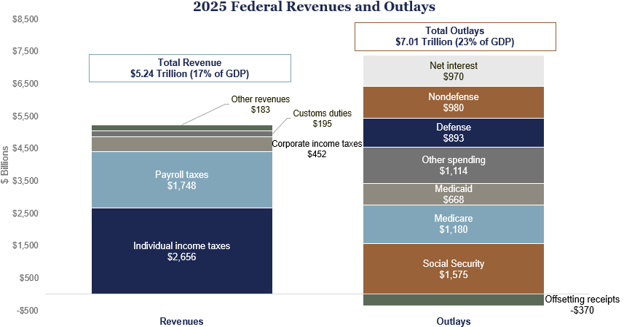
Source: Congressional Budget Office
Analysis: Stone Creek Advisors
Gross federal interest costs have exceeded $1.1 trillion annually.[4] As existing debt matures and is refinanced at higher rates, more federal revenue goes toward servicing obligations, leaving less room for GDP-enhancing spending and reducing flexibility in the next downturn.
Large deficits require additional borrowing at these higher rates, increasing Treasury supply. If investors demand higher yields to absorb that supply, government interest costs rise further, contributing to still larger deficits and becoming self-reinforcing.
This is not a new concern. In 1983, economist Ed Yardeni coined the term bond vigilantes to describe investors who discipline policymakers by demanding higher interest rates in response to inflationary or irresponsible fiscal policies.
As Yardeni observed: "So if the fiscal and monetary authorities won't regulate the economy, the bond investors will. The economy will be run by vigilantes in the credit markets."[5]
For decades, bond vigilantes have periodically resurfaced, only to retreat as central banks intervened, inflation moderated, or demand for government debt remained strong. But today’s environment is different. The Treasury must refinance enormous amounts of outstanding debt while corporations seek capital for the AI buildout. New borrowing must be absorbed alongside debt issued to replace maturing obligations. We are hitting maturity walls in Treasuries, municipal bonds, corporate bonds, and commercial real estate.
Meanwhile, the composition of Treasury buyers has changed. Historically, foreign central banks, com
mercial banks, and the Federal Reserve purchased government bonds for reasons unrelated to maximizing returns. More issuance must be absorbed by investors sensitive to price and expected returns. If those investors demand greater compensation, yields rise and the consequences extend far beyond government financing.
Higher for Longer May Mean Something Different This Time
Treasury markets experienced significant volatility during August and September as investors weighed resilient growth, persistent inflation risks, government borrowing requirements, and uncertainty surrounding monetary policy.
Much of the discussion about interest rates focuses on the Federal Reserve. Will it raise rates, lower them, or leave them unchanged? The Federal Reserve Chairman Keven Warsh said in Jackson Hole that he would be “hard pressed to describe broad financial conditions as restrictive.”[6] But we believe investors should pay just as much attention to what is happening further out on the Treasury yield curve.
While the Federal Reserve has considerable influence over short-term interest rates, longer-term rates are ultimately determined by investors' willingness to lend. Those investors may demand greater compensation for inflation risk, government borrowing, and committing capital over extended periods.
An important distinction today is the structure of outstanding debt. Many homeowners and corporations entered this period with long-term, fixed-rate borrowing secured when interest rates were exceptionally low. Consequently, higher market rates have not immediately translated into higher debt-service costs for every borrower, helping explain the economy’s resilience. Existing borrowers with low fixed rates have been insulated, while new borrowers and those with floating-rate debt have faced higher financing costs.
But that protection is not permanent. Corporate bonds mature, commercial real estate loans require refinancing, and businesses must finance new investment at prevailing rates, allowing higher interest rates to work their way through the economy gradually. The economy's resilience may not be evidence that higher rates no longer matter, but that their full effects take longer to emerge.
Mortgage rates, corporate borrowing costs, and equity valuations are heavily influenced by those longer-term yields. A Fed rate cut does not guarantee lower financing costs throughout the economy; investors ultimately determine if the bond market will allow longer-term borrowing costs to follow.
Notably, the Treasury Department used debt management tools to support liquidity in longer-dated Treasuries. Beginning in September, Treasury at least doubled the maximum size of its liquidity-support buybacks in the 10-to-20-year and 20-to-30-year portions of the Treasury market, increasing the maximum from $2 billion to at least $4 billion per operation.[7] They are simultaneously issuing enormous amounts of debt while becoming more active in managing liquidity at the long end of their yield curve, telling us something about how important the supply-and-demand balance in the Treasury market has become.
Foreign demand adds another wrinkle, particularly for longer-term debt. Japan, one of the largest foreign holders of U.S. Treasuries, has been intervening in currency markets to support the yen. Japanese Ministry of Finance data showed an $87.8 billion decline in foreign securities in August which could be associated with intervention activity, although U.S. Treasury data for August is not available until October 16th.[8] Japan's reported U.S. Treasury holdings had already fallen approximately $135 billion from February through July. [9] Currency intervention, reserve management, and international capital flows can influence demand for U.S. Treasuries. Japan and China remain important participants, even as their holdings and priorities evolve. We are also not the only country seeing yields moving higher, creating more competition for capital.
Investors may continue to demand greater compensation for holding longer-dated government debt. Historically, economic weakness produced lower interest rates, higher bond prices, and a reliable offset to equity-market declines. What happens if the next slowdown arrives while deficits remain elevated (or worsen), inflation is above target, and investors are demanding higher yields to finance government borrowing? Longer-term yields could remain elevated even as the Fed cuts short-term rates, potentially reducing the diversification benefits investors have come to expect from long-duration bonds.
We are not suggesting bonds will cease to diversify or that yields must continue rising. Rather, the relationship between monetary policy, inflation, government borrowing, and long-term interest rates has become more complicated. It is another reason we remain cautious about assuming the investment environment of the past will simply repeat itself and why we maintain a much shorter duration than the benchmark in client portfolios.
The Municipal Market Offers an Opportunity
Against this backdrop, August saw approximately $59 billion in municipal issuance, an exceptionally strong month for new supply. Demand remained healthy, supported by reinvestment flows, but the volume of issuance pressured prices, especially on the longer-end.[10] Municipal spreads were very tight going into the month and as supply accelerated and Treasury markets became more volatile, prices adjusted and yields rose.
Much of the weakness appeared driven by supply and demand rather than deterioration in municipal credit quality. At the end of the quarter, we began seeing opportunities and have been purchasing some high-quality municipal bonds in taxable accounts.
For select clients in high federal and New York tax brackets, certain bonds offered tax-equivalent yields above 7% after evaluating price, calls, credit quality and the relevant tax treatment. Yields could rise further from here, but we believe an absolute tax-equivalent yield over 7% is compelling enough for us to begin stepping in.
To manage duration, we sold the small exposure we had to the 7–10-year part of the Treasury curve. The two-to-ten-year part of the Treasury curve had flattened, and the three-to-five-year part of the curve offered yields only slightly below longer maturities, providing little incentive to assume additional risk. This allowed us to capitalize on improving fixed-income opportunities while maintaining discipline around portfolio duration.
We are adjusting the portfolio as we find areas where investors are better compensated for the risks they assume and have retained flexibility to add exposure if opportunities improve further.
What This Means for Equities
Following the Global Financial Crisis, exceptionally low interest rates supported higher valuations for financial assets. When high-quality bonds offered little return, investors took more risk in search of a better return. That environment particularly benefited companies whose expected earnings were concentrated far into the future.
But, when investors can earn meaningful returns on high-quality fixed income, the hurdle for taking equity risk rises. Higher yields driven by stronger economic growth can coexist with rising stock prices; but higher yields driven by inflation, fiscal concerns, or increasing Treasury supply are generally more challenging for equities.
Any slowdown in the AI cycle or growth could become trouble. These higher rates increase the return investors can earn without taking equity risk, raise the discount rate applied to future corporate earnings, and increase financing costs for businesses. This matters especially when market returns are concentrated in a small number of companies investing heavily in future growth.
This does not mean all equities are unattractive. Corporate earnings remain strong, and we continue to find opportunities across the structural themes discussed in previous letters, but selectivity matters more. In this environment, investors should pay greater attention to valuation, cash flow, balance-sheet strength, and returns on invested capital.
The Midterms and the Policy Outlook
The November midterm elections introduce another source of uncertainty. Changes in congressional control could affect the prospects for additional tax or spending legislation, regulatory priorities, and negotiations over future budgets. Markets may respond to the election outcome, but we would caution against assuming that either party’s victory automatically produces higher or lower returns. Regardless of the result, the next Congress will inherit the same structural challenge: large deficits, substantial refinancing needs, and a growing cost of capital.
Positioning for What Comes Next
We built Stone Creek Advisors on the belief that successful investing requires more than following a benchmark. Markets change, economic conditions evolve, and opportunities do not remain constant.
Fiscal spending and technological investment are creating extraordinary demand for capital. Higher borrowing costs can pressure consumers, businesses, governments, and equity valuations. Large deficits reduce policy flexibility, while increasingly concentrated economic growth creates additional vulnerabilities.
But those pressures can also create opportunities. The relationship between risk and return has improved in parts of the bond and equity markets, enough for us to dip a few toes in.
The bond market is finally calling. While we are not ready to answer with everything we have, we are certainly picking up a few of the calls.
As always, please reach out with any questions.
Kasey Wopperer
Co-Founder & Chief Investment Officer
Stone Creek Advisors
Stone Creek Advisors is a DBA of OneSeven, an SEC-registered investment adviser. Registration does not imply any level of skill or training. Titles reflect roles with Stone Creek Advisors. Investments are not FDIC insured and may lose value.
Please note, the information provided is for informational purposes only and investors should determine for themselves whether a particular service or product is suitable for their investment needs. Please refer to the disclosure and offering documents for further information concerning specific products or services. Investments in securities entail risk and are not suitable for all investors. Past performance is not a guarantee of future returns.
[1] The Budget and Economic Outlook: 2026 to 2036 | Congressional Budget Office
[2] US Corporate Bonds Statistics - SIFMA
[3] Capital Markets Fact Book - SIFMA
[4] Department of the Treasury Agency Financial Report Fiscal Year 2025
[5] https://old.yardeni.com/wp-content/uploads/Predicting-The-Markets.pdf page 19
[6] Federal Reserve, Chairman Kevin Warsh, Jackson Hole keynote, August 28, 2026: https://www.federalreserve.gov/newsevents/speech/warsh20260828a.htm
[7] https://home.treasury.gov/news/press-releases/sb0607
[8] https://www.mof.go.jp/english/policy/international_policy/reference/official_reserve_assets/e0808.html
[9] ticdata.treasury.gov/resource-center/data-chart-center/tic/Documents/slt_table5.html?trk=public_post_comment-text
[10] https://am.gs.com/en-us/institutions/insights/article/municipal-fixed-income-monthly